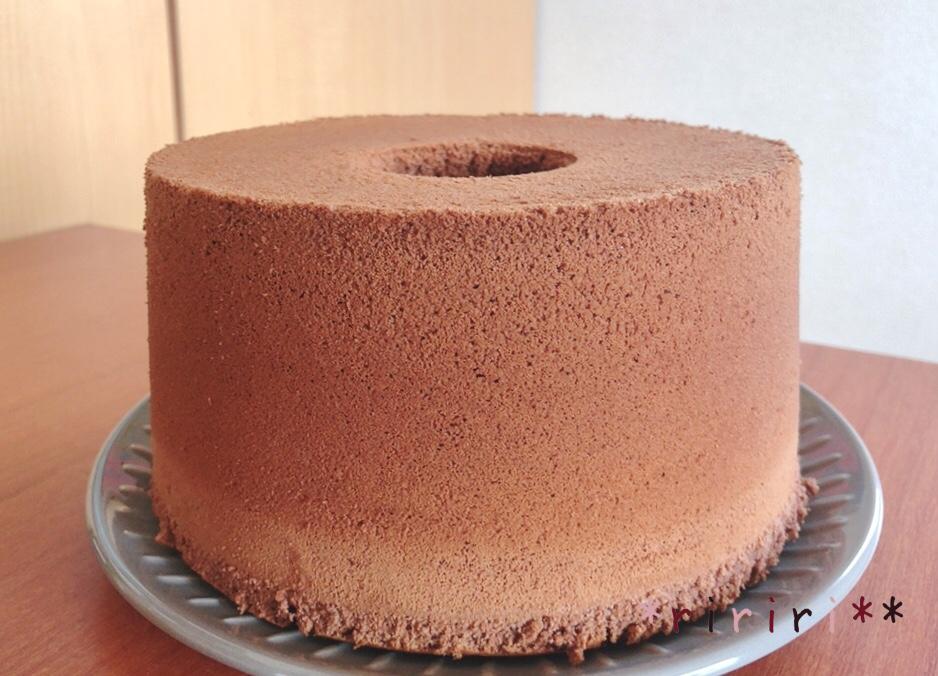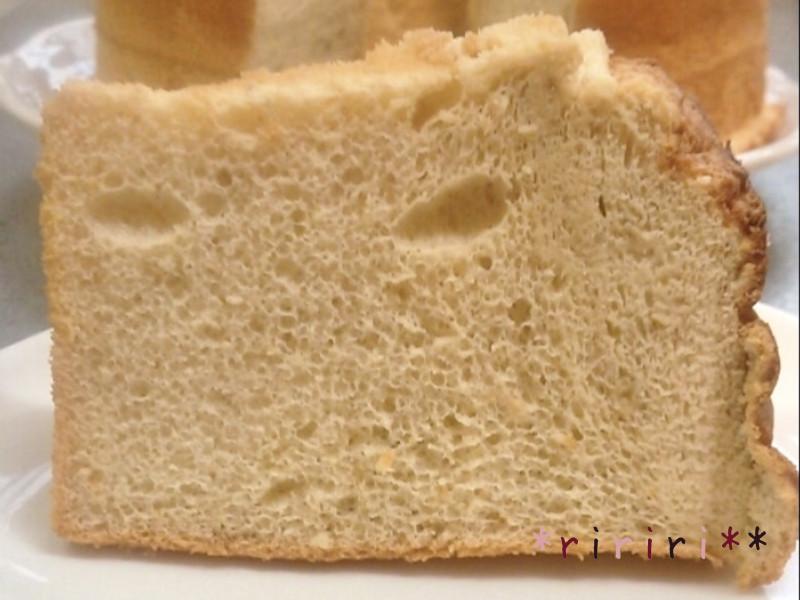
A concave or concave bottom is easiest to fix when you treat it as a structure problem, not as a mystery recipe failure. Work through batter emulsification, trapped air, final folding, and bottom heat in that order.
- Main symptom: The bottom rises, caves inward, or separates from the mold after baking.
- Most likely area: The batter structure near the bottom was unstable before it fully set.
- First comparison: If the side also collapses, compare with the collapse guide before changing ingredients.
- Emulsify the yolk batter: Mix oil, water, yolks, and flour until the batter is smooth and even, not streaky or separated.
- Remove large air pockets: Pour steadily, tap the mold, and run a skewer through the batter before baking.
- Check bottom heat: Use the same rack position and verify the real oven temperature before changing the recipe.
- Changing too many factors: If you change the oven, liquid, meringue, and mixing at once, the next result will not identify the cause.
- Folding only until the color matches: A uniform color is not enough; the final batter should also look smooth, glossy, and evenly fluid.
What a concave bottom usually means
A concave bottom usually starts before the cake is fully baked. The lower part of the batter cannot support itself evenly, so it lifts, dents, or separates as steam and heat move through the mold.
This is why the first checks should be batter quality and trapped air. Oven heat matters, but it is rarely the only cause.
- If the bottom is hollow but the side is stable, start with emulsification and trapped air.
- If the bottom and side both fail, compare the collapse guide too.
- If the crumb is wet or clogged, compare the shrinkage and dense texture guide.
Next-bake test order
Run the next bake as a controlled test. Keep the same recipe and change only the most likely cause first.
- Bake 1: improve yolk-batter emulsification and final folding.
- Bake 2: remove large air bubbles more carefully before baking.
- Bake 3: verify oven temperature and rack position.
- Bake 4: review oil choice and batter thickness if the problem repeats.
When to stop troubleshooting this page
If the bottom becomes stable but the cake loses height after cooling, move to collapse. If the top or crumb stays dense, move to shrinkage. The shape after cooling should choose the guide.
Is a concave bottom always caused by underbaking?
No. Underbaking can make it worse, but emulsification, trapped air, and uneven batter often start the problem earlier.
Should I change the recipe first?
No. First repeat the same recipe with better batter structure and controlled oven heat.
Chiffon cake failure pattern 1st Concave bottom (with a dent on the bottom of the chiffon cake)
First of all, what is a concave bottom of chiffon cake?
Have you ever been baked like this?
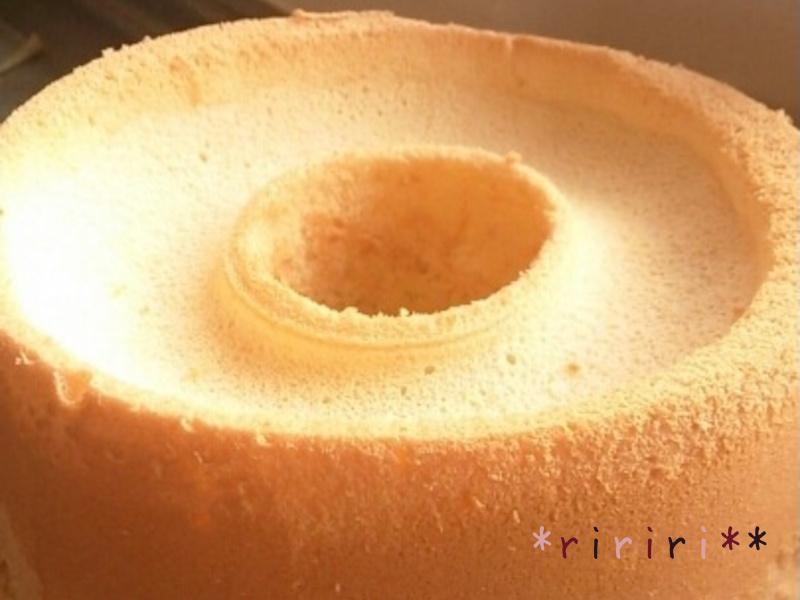
⇩ The bottom of the chiffon cake (the one that is on the bottom when baking) is raised and dented ⇩
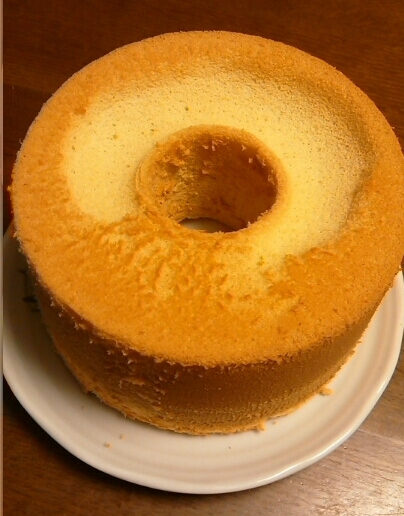
⇩ Some donut-shaped chiffon cakes are raised and dented ⇩
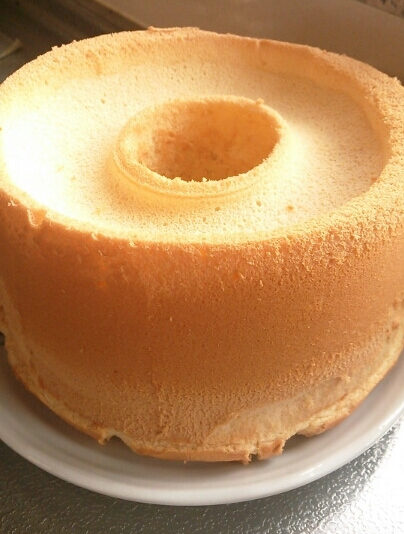
In this way, the state where the bottom part that is underneath when baking is dented when it is taken out of the mold is called “a concave bottom of the chiffon cake”.
Perhaps the most common mistake in making chiffon cake is a concave bottom.
Why is it such a raised state?
The causes of a concave bottom are roughly divided
1. Insufficient emulsification of egg yolk dough
2. Oven temperature is too high & too low
3. Other
There are three.
Cause of a concave bottom of chiffon cake Part 1: Insufficient emulsification of egg yolk dough
There are two types of emulsification: the water-in-oil type, in which oil embraces water, and the underwater oil-drop type, in which water embraces oil.
When the oil is in an emulsified state (water drop type in oil), the dough does not stick to the mold easily, so the dough can be easily separated from the mold, which leads to a concave bottom.
The reason why an explosive chiffon cake that rises abnormally during baking is created is that the dough does not stick to the bottom due to this insufficient emulsification, and only the force to rise upward remains.
but···
The recipe for chiffon cake always says, “Mix well and emulsify the yolk dough” no matter where you look.
I think that there are more people who “mix well and are conscious of emulsification”, though to varying degrees.
Nevertheless, there is a reality that the concave-bottom failure will not disappear. …
One of the reasons.
That is, the method of making egg yolk dough (emulsification method) varies depending on the recipe.
Some recipes mix well until it becomes whitish, others use a whisk to mix it manually (you don’t have to do it until it becomes whitish), or you can add it from the oil and then add water! Some recipes say, and some recipes add water and oil at once.
I’m following the recipe, but it doesn’t work!
Even though I mixed it well, I got a concave bottom! I think there are so many people who say that.
I have also failed many times by “mixing well” according to the recipe.
I couldn’t escape from a concave bottom even if I mixed it well enough that my hands hurt and the dough foamed properly.
At that time, I continued to make too many mistakes, saying, “Insufficient emulsification is the cause of raising the level of chiffon cake! In order to prove that, I was eager to create a concave bottom and mixed the egg yolk dough with a rubber spatula to intentionally create an under-emulsified state and bake it.
⇩ Click here for the chiffon cake at that time ⇩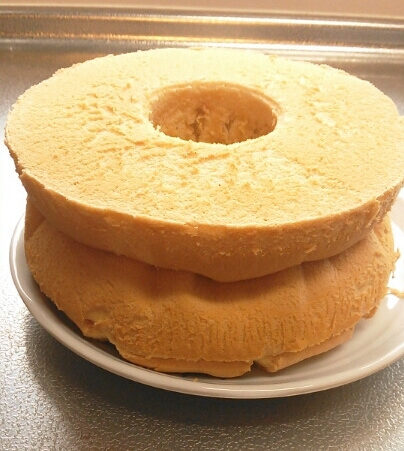
I have a terrible bend, but I haven’t got a concave bottom. “The cause of a concave bottom is insufficient emulsification,” I wanted to prove myself, but sometimes I didn’t create a concave bottom … (surprise)
What I learned at this time.
That is, “the emulsified state may be relatively unstable.”
Why do I fail when some people make it with the same recipe and succeed?
I used to think it was simply my lack of skill.
But
In the first place, the materials (eggs, milk, powder) used are not in the same state (quality and water content) every time, and the emulsification method and the result are unstable.
It’s not that I (you) who failed is bad! There must be a suitable method for each! about it.
That said, I don’t want to make mistakes, and I want to escape from the bottom-up hell!
I want to bake a beautiful chiffon!
You think so, right? ?? ??
Then what should I do? ??
I think one of the easiest solutions is to mix the egg yolk dough with a hand mixer until it becomes whitish and thick.
Based on my own experience of trying various methods of making …
Because of the instability, I recommend using a hand mixer to make egg yolk dough (whipped until whitish and thick) to ensure a stable and successful chiffon.
If there was a person who made it manually using a whisk and repeatedly got a concave bottom …
By all means, I would like you to try making chiffon cake with egg yolk dough using a hand mixer.
Cause of a concave bottom of chiffon cake Part 2: Oven temperature control
The most difficult thing for me is this “oven temperature control”.
This happens even if the creator has nothing wrong with it.
Even if the oven temperature is low, it will create a concave bottom, and if it is too high, it will create a concave bottom. And even if the heat conduction is bad, it will be raised.
I think there are the following points to determine that.
◎ What is the baking color when baking other sweets (the strength of the baking color when baked according to the recipe)
◎ The color of the side of the baked chiffon cake (whether it is baked or whitish)
◎ Placed on the top plate and baked (If placed on the top plate, is the top plate preheated?)
◎ The mold is too large for the inside of the oven (heat conduction is poor for a strong top heat)
If the bottom heat is weak and the heat conduction is poor, preheat and bake the whole top plate (or remove the top plate and bake), bake on a net instead of the top plate, and place directly (even in a rotating type oven, put a round plate) I think that it will be improved if you try (except for placing it directly on the turntable).
If the heating power is strong, lower the preheating temperature and adjust the firing time and firing temperature.
(I hear that the bottom raising was solved by making a notch in the upper part of the chiffon dough during baking.
I think this method is also effective if you are using a type of oven that has a strong heating power and the temperature inside the oven does not easily drop, but be aware that it may have the opposite effect if the type tends to drop in temperature. .. )
This is the most annoying part because the only solution is to grasp the habit of the oven.
If you can’t escape from a concave bottom even though you’re devoting yourself to making the dough, it’s most likely due to the oven.
The quickest solution is to buy an oven thermometer.
👉Click here for oven thermometer
After listening to my own experience and the voices of many people … Is the preheating completion alarm of the oven less than 5% credit? I’m sure you will think that.
Ovens are devices that have their own quirks, so if you can’t escape from a concave bottom, I would like you to purchase an oven thermometer and check the actual temperature.
Cause of a concave bottom of chiffon cake Part 3: Oil, molds, final dough, etc.
Concave bottom of chiffon cake does not always occur due to the above two causes.
As another cause
◎ Uses oil containing emulsifier (healthy resetter, zero cholesterol, etc.)
◎ Air entered when molding
◎ Insufficient mixing of final dough
And so on.
◎ First, oil with emulsifier!
When making chiffon cakes, I often see a note saying “I don’t use healthy oils”, but the correct answer is “I don’t use oils with emulsifiers”.
The dough making is not bad, and the oven temperature is not bad, but the bottom is raised! If so, you may want to look at the label on the back of the oil package that has been used once to see if any emulsifiers have been added.
Next, about air mixing at the time of molding.
⇩ If air gets in when putting in the mold Part 1 ⇩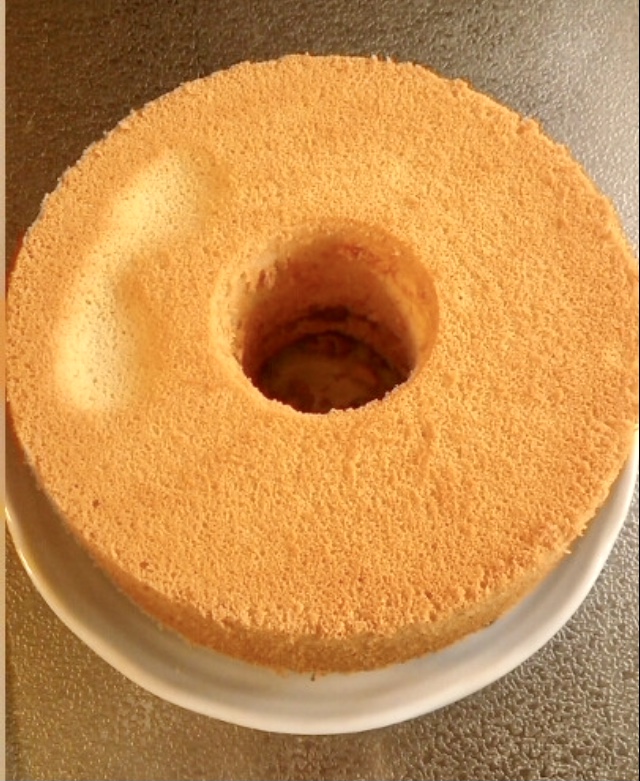
⇩ If air gets in when putting in the mold Part 2 ⇩
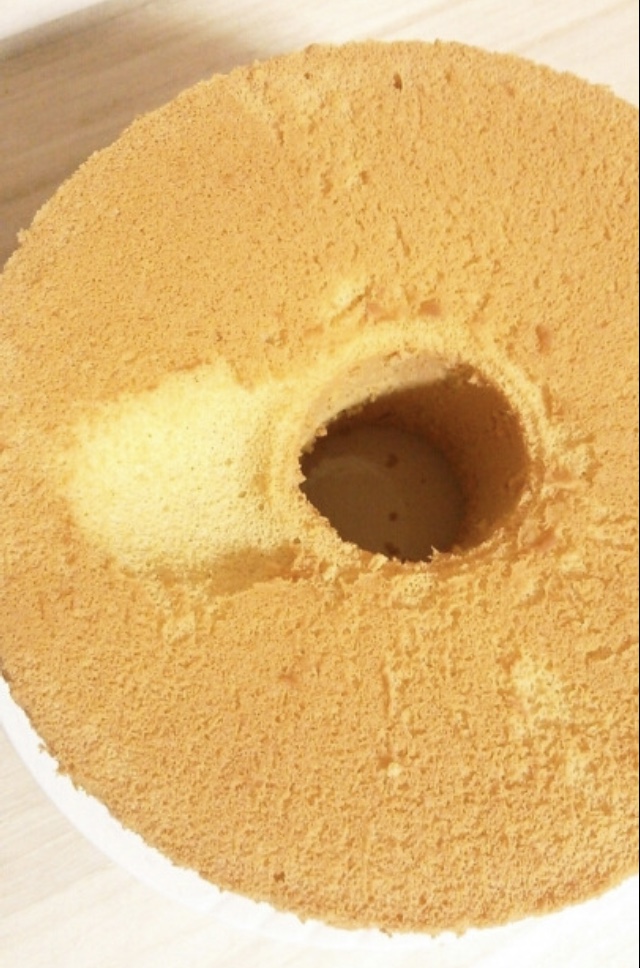
This kind of bottom-up often occurs when the final dough is thick and firm, and the dough fits into the mold.
The solution is to mix the final dough a little more (adjust the hardness of the dough), bleed the air with chopsticks after pouring it into the mold, and do not hit it with a ton tongue after pouring it into the mold (when air enters from the bottom part in reverse). There is) and so on.
👉Click here for details on how to mold and bleed chiffon cake dough
(Chiffon cake mold)
Finally, about the lack of mixing of the final dough.
If there is unevenness or insufficiency in the mixture of egg yolk dough and meringue, it will lead to the water and oil content scattered throughout the chiffon dough and the instability of its emulsified state, which may eventually lead to a concave bottom (probably).・ ・ ・)
If not only air is simply introduced, but also insufficient mixing of the final dough is combined, it will add to a concave bottom, causing shrinkage, large holes, and meringue residue.
⇩ Chiffon cake baked with meringue left ⇩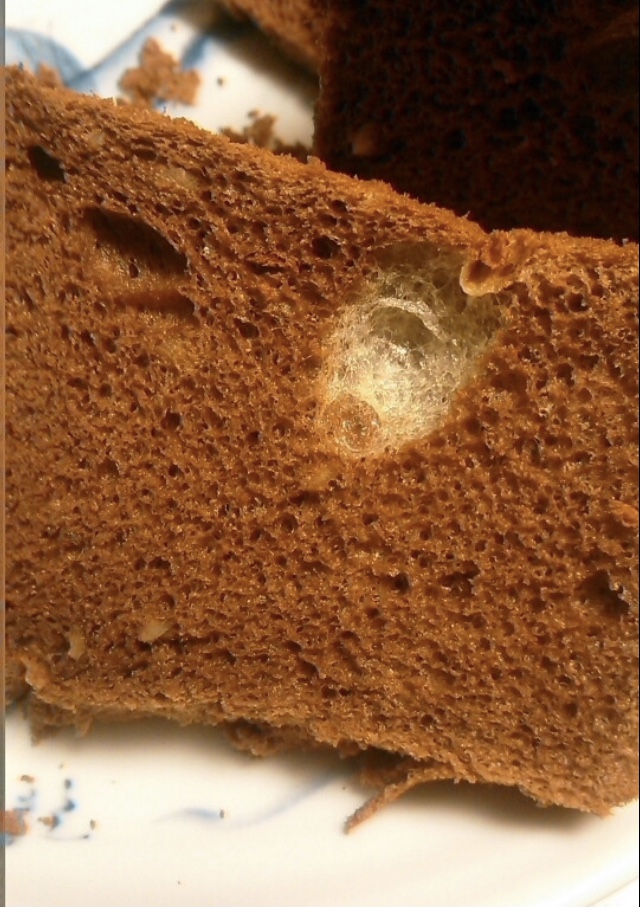
Summary of how to eliminate the bottom raising of chiffon cake
How was it?
There is more than one cause for “a concave bottom”, and some people may find it difficult because there are many things to be aware of.
So a simple solution!
◎ Use a hand mixer to whisk the egg yolk dough until it becomes whitish and thick.
◎ Warm water and oil to make it easier to emulsify.
◎ Mix egg yolk dough and meringue evenly and carefully
◎ Introduction of oven thermometer
These are the above four points.
Failure to make chiffon cake often occurs due to a combination of various factors such as “egg yolk dough,” “meringue,” “mixing,” “oven temperature,” “baking time,” and “blending.”
So, “If this happens, it will be solved immediately! There is a part that cannot be said, and I think that is the difficulty of chiffon cake.
So I think there are some causes and solutions that I haven’t noticed yet.
If you notice something, we will update and change the contents each time, so feel free to contact us on Twitter … (* ^^ *)